


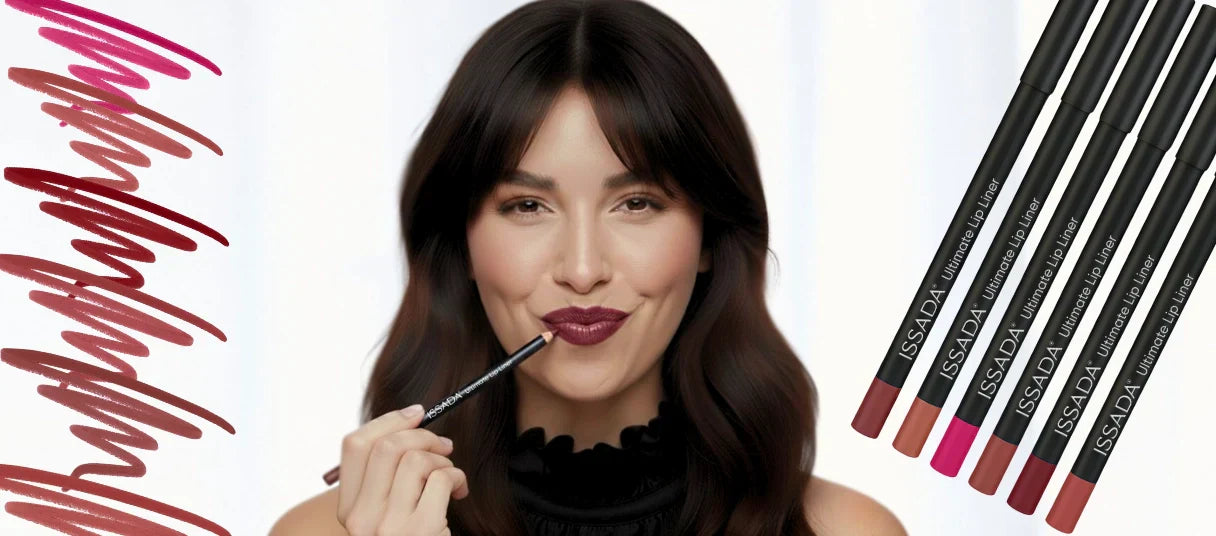


What's the purpose of lip liner?
Well, there's three main ones:
1. It helps define your lip shape. Emphasise that Cupid's bow or draw a straighter line to give them a much more definite edge.
2. Corrects and enhances your natural lip shape by making them appear more even and symmetrical and plump by lining the outer edge of your natural lip line slightly beyond.
3. Lastly, it's there for the long-haul. Using lip liner as a base will make your colour stay 10 times as long and will wear off more evenly when it eventually does
The Universal Lipstick Problem
You apply lipstick in the morning, and it looks polished. Then real life happens. Coffee on the commute. A quick chat with a colleague. Lunch. A few hours of talking in meetings. By mid-afternoon, the colour has shifted, faded in the centre, or feathered at the edges.
This is not always a “bad lipstick” problem. It is often a lip anatomy + technique problem.
Lips are a high-movement area with constant contact from saliva, food, drink, and natural oils. Even premium lipsticks can struggle if the surface underneath is not prepared and the colour is not anchored properly.
The step most people skip is simple but makes a measurable difference: using lip liner as a full-lip base, not just a border. Professional makeup artists use this approach because it improves how colour grips, how it fades, and how easy it is to touch up without rebuilding the whole lip.
Why Lip Colour Fades So Quickly
To get longer wear, it helps to understand what you are working with. Lips are not like the rest of the face.
Natural Lip Anatomy: Movement, Moisture, And Texture
Constant Movement: Talking, smiling, eating, and drinking create friction that breaks down pigment and shifts product.
Moisture Exposure: Saliva softens formulas and increases transfer.
Uneven Texture: Dry patches can cause colour to cling in some areas and disappear in others.
In Australia, where many people move between air conditioning, heat, wind, and outdoor conditions in the same day, lips can also dehydrate quickly. Dehydration does not just feel uncomfortable. It can change how lipstick sits and wears.
Common Culprits Behind Fading
Eating, Drinking, and Talking: The inner lip area is the first to fade because it is the highest contact zone.
Saliva and Natural Oils: Saliva gradually breaks down the product at the inner rim. Natural oils from food can also dissolve waxes and soften pigment.
Over-Reliance on Lipstick Formulas Alone: Many lipsticks balance comfort, colour payoff, and finish. Longevity is influenced by those choices.
Myth-Busting: Why “Long-Wear” Lipstick Isn’t A Complete Solution
“Long-wear” can help, but it is not a universal fix. Some long-wear formulas feel dry or fade unevenly, especially if lips are dehydrated. The most reliable improvement often comes from technique: a grippy base + thin layers + strategic touch-ups.
It is also important to remember that cosmetic longevity must be balanced with skin comfort and safety. In Australia, cosmetic products are regulated under national safety standards overseen by the Therapeutic Goods Administration (TGA), which sets requirements around ingredients, labelling, and consumer protection. While regulation supports product safety, wear performance still depends heavily on application method and lip condition.
The Lip Liner Mistake Most People Make
Most people use lip liner in one of two ways:
- Outline the lips, then apply lipstick.
- Overline slightly, then apply lipstick.
Both can look great at first. The issue is what happens after a few hours.
How Most People Use Lip Liner
- They outline the lip border.
- They may shade slightly at the corners.
- They leave most of the lip surface bare before lipstick.
Why Outlining Alone Can Break Down Faster
When only the perimeter has a liner, you create two different surfaces:
- Outer Edge: More grip (liner)
- Inner Lip: Less grip (bare lip)
As lipstick wears, the inner area fades first. The outline can remain visible longer, which can look harsh or uneven, especially with deeper shades.

The Missing Step: Using Lip Liner As A Base
Instead of treating lip liner as a border, treat it as a foundation layer. That means filling the entire lip with liner first, then applying lipstick over the top.
How Lip Liner Acts As A Base
Lip liner typically has a firmer, more structured texture than lipstick. It can create a more stable layer for lipstick pigment to adhere to, which improves wear and reduces uneven fading.
This technique pairs particularly well with lip products designed to be layered, such as those found in the ISSADA lip collection.
Why This Step Can Improve Longevity
A full-lip liner base can help:
- Improve how lipstick grips across the whole lip
- Reduce the “bare centre” fade pattern
- Maintain cleaner edges for longer
- Make touch-ups faster and more controlled
How To Do It Properly: Step-By-Step Technique
Step 1: Prep The Lips
- Lightly exfoliate using a soft, damp face cloth.
- Apply a small amount of lip balm, allow it to absorb, then blot.
Features: A smoother, more even surface
Benefits: More even pigment placement and less patchy wear
Step 2: Choose The Right Lip Liner
- Avoid liners that are overly slippery or overly dry.
- Match to lipstick for seamless wear, or choose a neutral tone for versatility.
Features: Suitable texture and shade compatibility
Benefits: Cleaner blending, easier touch-ups, and more natural fading
Step 3: Fill In The Entire Lip With Liner
- Lightly outline the lips.
- Use short, light strokes to shade the entire lip surface.
- Keep the layer thin and even.
Features: Full-lip pigment base
Benefits: More even wear, less patchiness, and improved edge control
Step 4: Apply Lipstick Strategically
1. Press colour into the liner base rather than swiping heavily.
Use a blot-and-layer approach:
- Apply a thin layer
- Blot
- Apply a second thin layer
Feature: Layered colour placement
Benefit: Helps lipstick wear more evenly and reduces transfer
Step 5: Lock It In (Optional)
1. Tissue-Setting Method: Place a single layer of tissue over the lips and lightly press translucent powder through it
2. Lip Sealers: Optional, but may not suit dehydrated lips.
Feature: Optional setting step
Benefit: Can reduce transfer and support longer wear
Product Spotlight: ISSADA Mineral Ultimate Lip Liner
Features:
- Pure Mineral-Based Lip Liner Designed To Line, Shape, And Fill The Lips
- Smooth, Creamy Texture For Controlled Application
- Rich Pigment Payoff
- Shade Range: 13 Shades Across Nudes, Pinks, Brights, And Deeper Tones
- Paraben Free / Vegan / Gluten Free / Dermatologically Tested / Long Lasting
- Size: 1.4g / 0.05oz
- Ingredients Listed On Page Include: Minerals, Jojoba Seed Oil, Chamomile, Safflower Seed Oil, Cotton Seed Oil, Soybean Oil, Vitamin C (Ascorbyl Palmitate), Vitamin E (Tocopherol)
- Sharpening Recommendation: Best Sharpened With The ISSADA Precision Sharpener (German Steel Blade)
Benefits
- Helps create a precise definition that wears more evenly over time
- Described on page as helping reduce feathering, fading, and bleeding
- Can be used to stretch colour across the whole lip as a base
- Glides on smoothly for easier, more controlled application
- Designed for long-wearing, transfer-resistant results
- Supports lip shape correction
Directions For Use
- Sharpen before use
- Apply directly to the lip border and shade in towards the lip interior
- Follow with your favourite ISSADA Lip Shade or wear alone
Professional Tip: Also suitable to use on the eyes as an eyeliner
Common Lip Liner Errors That Ruin Longevity
- Using slippery products underneath
- Overdrawing without structural support
- Skipping lip prep
- Mixing incompatible formulas
When Lip Liner Alone Is Enough
- Matte liner-only looks
- Natural, no-lipstick days
- Touch-up friendly wear for long events
Pro Tips For All-Day Lip Colour
- Sip from the side of the cup rather than pressing lips firmly to the rim
- Touch up the centre first
- Avoid piling heavy layers over broken-down product
- Keep your liner in your bag for quick refreshes
FAQ
Does This Work For Glossy Lips?
Yes, but longevity will still be shorter than matte finishes. Use liner as a base, apply lipstick, blot once, then add gloss only to the centre.
What If My Lips Are Very Dry?
Use gentle exfoliation and light hydration, then blot. Avoid thick balm underliner.
Can I Use A Nude Liner With Bold Lipstick?
Yes. Choose a nude close to your natural lip tone. For deeper shades, a closer-match liner often looks cleaner as it fades.
Should I Always Outline First?
Outline lightly to map the shape, then fill the whole lip.
Can I Wear Lip Liner On Its Own?
Yes. Liner-only can be a defined, low-maintenance option that is easy to touch up.
About the Author
 |
Lynette Rouse - General Manager of ISSADA With over 30 years of experience in skincare and wellness, Lynette Rouse brings deep industry expertise and a global perspective to ISSADA. She has worked alongside leading dermatologists and cosmetic chemists worldwide and is internationally recognised for developing an award-winning skincare bioactive that continues to shape evidence-based beauty. Passionate about connecting science, innovation, and care, Lynette leads ISSADA with authenticity and a commitment to skin health and confidence. Know more about her in our About Us page. |


Leave a comment