




“Clean beauty” is everywhere now. Question is, what sits behind the label.
A polished ingredient list can tell you part of the story, but it doesn’t explain why a formula was created, how its ingredients were chosen, whether those ingredients remain stable over time, or what happened before the product reached to your bathroom shelf.
At ISSADA, product development begins with the skin itself.
Our team looks at concerns such as barrier dysfunction, oxidative stress and premature ageing, then works backwards from the result we want to achieve. From there comes ingredient research, formulation, testing, professional feedback and, eventually, a finished product.
That process applies to skincare and makeup alike. A 25% Vitamin C Serum and a Mineral Velvet Cream Foundation may look very different on the outside, but both require careful decisions about ingredients, texture, stability, packaging and how the finished formula behaves on real skin.
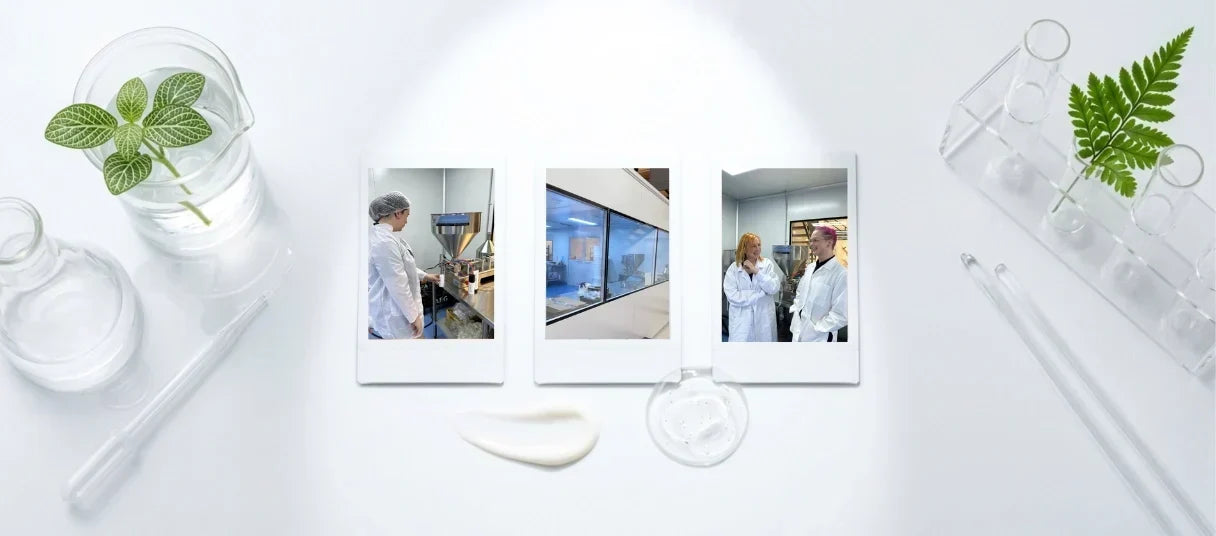
Much of that work happens at our Gold Coast facility, where we can stay closely involved from the first formulation brief through to manufacturing.
This article explains how a cosmeceutical makeup and skincare formula is developed from skin concern and ingredient selection through stability testing, PET, packaging compatibility and manufacturing.
Key takeaways
- ISSADA develops formulas around specific skin concerns rather than short-lived beauty trends.
- Ingredient selection considers purity, concentration, compatibility, molecular weight and the role each ingredient plays in the finished formula.
- Stability testing, Preservative Efficacy Testing and packaging assessments help determine whether a product remains safe and usable throughout its intended shelf life.
- Feedback from practitioners, clinics and professional stockists helps refine products before launch.
- ISSADA formulations follow the brand’s vegan and cruelty-free standards and exclude ingredients including parabens, talc, mineral oils and nanoparticles.
Table of Contents
- The Starting Point: Understanding the Skin
- How a Formula Takes Shape
- Formulating Mineral Makeup
- Manufacturing, Safety and Ethical Standards
- Testing a Formula Before Launch
- Getting Texture and Finish Right
- Packaging and Stability
- From the Lab to Your Daily Routine
- What Comes Next for ISSADA Product Development
- Frequently Asked Questions
Starting Point: Understanding the Skin
A new formula doesn’t begin with a trending ingredient and a catchy product name.
It begins with a problem.
That might be a weakened skin barrier, oxidative stress, sensitivity, dehydration or visible signs of premature ageing. First job is to understand what is happening in the skin and what kind of formula could realistically support it.
That sounds obvious, but it changes the way a product is built.
Rather than asking, “Which ingredients are popular right now?”, our development team looks at what each ingredient needs to do inside the formula. Purity matters. Concentration matters. So does molecular weight, compatibility with other ingredients and how the skin is expected to interact with the finished product.
An ingredient also has to earn its place.
A long ingredient list might look impressive, but adding more components does not automatically create a better formula. We want each ingredient to contribute something useful, whether that means supporting the active ingredients, improving stability, helping the product feel better on skin or addressing the concern that led us to develop the formula in the first place.

Combining Clinical Actives with Botanicals
This is where our “Clean Science” approach comes in.
When we develop products such as Retinol Serum or Vitamin C Serum, the goal isn’t simply to use a potent active at all costs. Potency has to sit alongside tolerability.
That means looking at how active ingredients can be paired with plant-derived ingredients that help keep the formula sitting comfortably on the skin.
Sometimes formulation is a balancing act. An ingredient may perform brilliantly in isolation but behave differently once it is combined with the rest of a formula. A promising prototype can be too heavy, too unstable or simply unpleasant to use.
So we adjust. Then test. Then adjust again. Until we get the right combination of actives.
What practitioners tell us matters
Laboratory gives us controlled information. Clinics tell us what happens in everyday practice. ISSADA works with dermatologists, doctors, aestheticians, professional stockists and practitioners at ISSADA Studios. Their feedback gives our development team another perspective, particularly when products are being used alongside with professional treatments.
For example, practitioners may notice different skin needs after treatments like chemical peels or laser therapy.
That feedback can influence a new product or change an existing prototype. It can also help us develop targeted skincare packs that make a professional routine easier to follow at home.
The point is simple: a formula has to work outside the lab.
How a Formula Takes Shape
Formulation is chemistry, but anyone who has used a serum that pills under moisturiser or a foundation that separates by lunchtime knows chemistry is only part of the experience.
Every component has to work with the others.
That includes active ingredients, emulsifiers, stabilisers, preservatives and the ingredients responsible for texture and application.
pH is another part of the equation. Our chemists calibrate formulas with the skin’s acid mantle in mind, particularly when working with ingredients that can become irritating or less effective outside an appropriate pH range. Then there is molecular weight.
Adding an active ingredient to a formula does not automatically mean it will behave exactly as intended. Its form, size, concentration and delivery within the formula all affect performance.
With products such as Niacinamide + B5 Complex Serum, these decisions are considered during development so the niacinamide can play the role the formula was designed around.
It’s detailed work. Most of it will never be visible on the packaging, but it shapes what happens when you actually use the product.
Choosing Cosmeceutical Actives
ISSADA uses pharmaceutical-grade vitamins and minerals selected for purity and potency.
Higher concentrations of active ingredients can also create formulation challenges. Some ingredients are sensitive to light, air, temperature or their surrounding environment.
Vitamin C is a good example.
Putting it into a serum is the easy part. Keeping the formula stable and useful from the first application to the last takes considerably more work.
That is why stabilisation, packaging and compatibility testing are part of product development rather than an afterthought.
Formulating Mineral Makeup
Makeup has its own set of problems to solve.
Colour has to be consistent. Pigment needs to apply evenly. Texture has to feel right. The finished product also needs to sit comfortably on skin for hours.
ISSADA mineral makeup is formulated without talc and mineral oils. Instead, we work with high-purity minerals and use processes designed to achieve the texture, coverage and the finish we want without relying on those traditional fillers.
Our Mineral Luminous Loose Powder Foundation, for example, goes through a triple-milling process and is micronised for ultra-fine spherical powder particles. Our Mineral Velvet Cream Foundation is a breathable, cosmeceutical foundation that blends advanced skincare technology with seamless coverage, leaving the complexion naturally smooth and perfected.
The idea behind our makeup range has always been that wearing makeup shouldn’t mean forgetting about the skin underneath it.
That’s also why we pay attention to the minerals themselves and the skin-supportive qualities we want from the finished product.
A complexion product still has to look beautiful. Of course it does. We simply think it should feel good on the skin too.
Manufacturing, Safety and Ethical Standards
Keeping manufacturing close to home gives us more control over what happens between a laboratory sample and a finished product.
ISSADA develops and manufactures formulas at our Gold Coast facility rather than handing the process over and hoping the final batch matches the original brief.
That allows us to keep a closer eye on raw materials, production and consistency between batches. It also means problems are easier to investigate. If a texture changes or a raw material behaves differently, the people responsible for developing the formula are close to the people manufacturing it.
What We Leave Out
Our formulation standards also include ingredients we choose not to use.
ISSADA products are formulated without parabens, talc, mineral oils and nanoparticles.
Removing an ingredient is not always as simple as deleting it from a recipe. If that ingredient was helping with preservation, stability, texture or application, something else has to perform the same job.
That can mean more development work, but it allows us to formulate within the standards we have set for the range.
Vegan and Cruelty-free Development
ISSADA does not test finished products or individual ingredients on animals.
Our development process also prioritises vegan-friendly ingredients, including in products such as Amplify Lash Serum and Mineral Baked Velvet.
Replacing an animal-derived ingredient can create its own formulation challenges. The alternative still needs to perform properly, remain stable and deliver the texture customers expect.
For us, those requirements are part of the development brief rather than something added after the product has been created.
Australian Standards and Product Claims
Safety and product claims need evidence behind them.
ISSADA develops products within Australian regulatory requirements, including relevant TGA standards where they apply, and uses testing and documentation to support product safety and performance.
Dermatological testing is also part of the process for products intended for sensitive or reactive skin, including formulas such as Daily Gentle Cleansing Gel. There’s a practical reason for being careful here.
A formula should be able to stand on what it actually does. Marketing shouldn’t have to invent the rest.
Testing a Formula Before Launch
A prototype that looks perfect on the day it is made is still just a prototype.
We need to know what happens after weeks or months.
Will the emulsion separate? Will the texture change? Will exposure to temperature affect it? Will the preservation system continue doing its job?
Stability testing helps answer those questions.
During development, formulas are exposed to controlled temperature changes and other conditions designed to reveal potential problems before a product goes into full production.
We also use Preservative Efficacy Testing, or PET, to assess the preservation system and help confirm that a product can remain safe throughout its intended lifespan.
It isn’t the glamorous part of beauty product development. It may be one of the most important.
Professional Testing Outside the Lab
Before a national launch, selected products can also go to professional stockists for feedback. Aestheticians and clinicians use products in conditions that are difficult to mimic perfectly in a laboratory.
They notice things.
Maybe absorption needs to be slightly faster. Perhaps the texture feels too rich when layered with another treatment. Sometimes a formula performs well but needs a small adjustment before it feels right in a professional setting.
Those observations come back to the development team.
Occasionally the change is tiny. Tiny changes can make a surprisingly big difference.
Getting Texture and Finish Right
Skincare has to perform, but people also have to want to use it.
A cleanser should work well and feel good enough to use every night.
So sensory testing matters too.
With Daily Gentle Cleansing Gel, for instance, we want enough substance for the product to feel satisfying during massage, followed by a clean rinse without an unwanted film.
Mineral makeup creates different challenges.
For Mineral Beach Babe, infused with light-reflecting rose-gold flecks, the formula adds a natural radiance to every skin tone while pure botanical extracts help nourish the skin.
We use the natural aromas of botanical ingredients instead of adding extra fragrance.
These details may seem small when written on a formulation sheet. You’ll notice these little details every time you use the product.
Packaging and Stability
Sometimes the formula isn’t the only factor that affects stability. The container matters too.
Packaging can affect exposure to oxygen, light and repeated handling. The formula and the packaging therefore have to be tested together.
That is particularly important for more sensitive actives.
Products such as Retinol Serum may need airless or UV-protective packaging to reduce exposure that could affect the formula over time.
We also assess whether the packaging itself is compatible with the product it contains.
For professional settings, where a product may be opened and handled frequently, those decisions become even more relevant.
Shelf-life testing helps us establish how long the product should remain stable and effective once it reaches the person using it.
From the Lab to Your Daily Routine
After the research, ingredient sourcing, prototypes, testing and professional feedback, the final product has one last job.
It has to fit into real life.
ISSADA has a range of more than 500 products, which allows practitioners and customers to build routines around individual skin concerns rather than treating every complexion the same way.
That doesn’t mean more products are always better.
Often, a carefully chosen routine is more useful than an overflowing bathroom cabinet.
Someone might use 25% Vitamin C Serum and Niacinamide + B5 Complex Serum in the morning, for example, then include Enzyme Resurfacing Moisturiser in an evening routine where appropriate.
For makeup, Primer can be paired with an ISSADA mineral foundation to create the desired finish while keeping the broader skin-focused approach consistent.
What belongs in a routine will always depend on the person using it.
Development work behind each individual formula simply gives practitioners and customers better tools to choose from.
Explore ISSADA complexion products.
What Comes Next for ISSADA Product Development
What comes next for ISSADA product development
Launching a product doesn’t mean the research stops.
New dermatological research continues to emerge. Ingredients improve. Packaging changes. Manufacturing technology changes too.
ISSADA continues to invest in its Gold Coast facility while exploring new formulation technologies and more sustainable packaging options.
We expect some ideas to work immediately and others to need several rounds of development. That’s normal.
A useful product doesn’t need a dramatic origin story. It needs a clear reason to exist, a formula that holds up under testing and an experience that makes people want to keep using it.
That is the standard we come back to.
Explore ISSADA’s vegan and cruelty-free range.
Frequently Asked Questions
How long does it take to develop a new ISSADA skincare product?
A new formula can take around 12 to 24 months to move from the initial concept to a finished product.
That time allows for formulation work, multiple prototypes, stability testing, packaging assessments and professional feedback.
Some formulas come together more quickly than others. Products with sensitive active ingredients or more complicated textures can require additional rounds of adjustment before they are ready.
What is the difference between a cosmetic and a cosmeceutical formulation?
ISSADA cosmeceutical formulas use pharmaceutical-grade active ingredients selected for their purity, concentration and intended role in supporting skin health.
Traditional cosmetics may focus primarily on how the skin looks or feels at the surface. Cosmeceutical development places greater emphasis on active ingredients and the way a formula is constructed around a particular skin concern.
Are ISSADA products tested on animals?
No. ISSADA does not test its ingredients or finished products on animals.
Our product development standards also prioritise vegan-friendly formulations across the range.
How do Australian regulatory standards affect skincare claims?
Australian regulatory requirements influence which claims can be made about a product and what evidence is needed to support them.
ISSADA follows relevant standards and testing requirements when developing formulas and communicating their intended benefits.
For us, that means product claims should reflect what the formula and its supporting evidence can reasonably demonstrate.
Why does ISSADA avoid talc and mineral oils in makeup?
ISSADA mineral makeup is formulated without talc and mineral oils.
Instead, we use high-purity minerals selected to create the coverage, texture and finish we want while supporting our broader skin-focused formulation approach.
Can people with sensitive skin use clinical-grade skincare?
Sensitive skin needs thoughtful product selection, regardless of how a product is categorised. If your skin is extremely reactive or you are managing a diagnosed skin condition, professional guidance can also help you build an appropriate routine.
What role do dermatologists and practitioners play in product development?
Professional feedback gives our development team information that laboratory testing alone cannot provide. Dermatologists, aesthetic doctors, clinicians and other practitioners can report how products behave with different skin concerns and in professional environments, including alongside treatments. That feedback may influence texture, absorption, product positioning or the way a formula is ultimately used.
How do you keep ingredients such as retinol and Vitamin C stable?
Sensitive active ingredients can be affected by factors such as light, oxygen and temperature. We consider those risks when developing the formula and choosing its packaging. Depending on the product, that may include airless or UV-protective containers as well as stability testing before release.
The goal is straightforward: the formula in your final application should still perform the way it was designed to perform.
A Formula You Can Understand
Knowing how skincare and makeup are developed makes it easier to look beyond the front of the bottle.
There is the ingredient list, of course. Then there are all the decisions you don’t see: why those ingredients were chosen, how they work together, how the texture was refined, how the formula was tested and whether the packaging protects what is inside.
That is the part of product development we think deserves more attention.
At ISSADA, those decisions happen close to home at our Gold Coast facility, with input from our chemists, practitioners and professional partners.
The finished product might be a serum, cleanser or mineral foundation.
The process behind it starts much earlier.

Disclaimer: This content is for general information and isn't a substitute for advice from your own dermatologist, particularly if you have sensitive skin or a diagnosed skin condition.


Leave a comment