




Updated August 28, 2026
If you've ever finished an entire jar of skincare and realised nothing much changed (other than your bathroom shelf looking nicer), you're not alone. Usually it comes down to a handful of practical things: which active ingredient is used, whether the formula stays stable, and whether the product actually suits your skin.
You'll often see the word cosmeceutical used to describe higher-performance skincare that sits somewhere between everyday cosmetics and clinic-adjacent routines. In Australia, it's largely a marketing term: the products themselves are still regulated as cosmetics unless they make therapeutic claims.
This guide covers what cosmeceutical skincare actually means, how it differs from standard cosmetic skincare, what people usually mean by *clinical-grade*, and how to build a routine that supports healthier-looking skin over time without drifting into medical-claim territory.
Key Takeaways
- Cosmeceutical is a widely used term for cosmetic skincare built with higher-performing actives and closer attention to stability and delivery.
- The real difference usually comes down to concentration, formulation stability, and how a product is designed to perform on skin, not just how it feels.
- Clinical-grade typically points to quality control, ingredient selection, stability, and professional-use standards, not a promise to treat a medical condition.
- The best results come from matching the right active to the right concern and sticking with it.
Table of Contents
- Defining the cosmeceutical meaning
- Is cosmeceutical a regulated term in Australia?
- Cosmeceutical vs cosmetic: what is the difference?
- What does clinical-grade skincare actually mean?
- Key active ingredients in cosmeceutical skincare
- A practical routine: skincare first, makeup second
- FAQ
Defining the Cosmeceutical Meaning
Cosmeceutical blends "cosmetic" and "pharmaceutical," but that doesn't make the product a medicine.
In everyday skincare language, cosmeceutical usually signals three things. First, It's still legally a cosmetic (appearance-focused claims only). Second, it contains well-studied active ingredients such as vitamin C, niacinamide, retinoids, and the like. Lastly, it is formulated with more attention to stability, texture, and performance than a lot of mass-market products.
In short, cosmeceutical skincare is made to do more than just to feel good on your skin. It is designed to deliver real, targeted results too.
Is Cosmeceutical a Regulated Term in Australia?
Not really. Australian skincare is generally regulated by the claims it makes, not by what it is called.
- Products making therapeutic claims (treating a disease or medical condition) can fall under therapeutic goods regulation.
- Products making cosmetic claims (improving the appearance of hydration, brightness, texture, or fine lines) stay classified as cosmetics.
That's why most of the beauty brands watch their wording closely. It should be appearance and skin comfort, not medical treatment.

Cosmeceutical vs Cosmetic: What is the Difference
Both cosmetic and cosmeceutical skincare can improve how your skin looks. What usually differs is how intentionally the product was built to do that.
Three things tend to separate them:
- Active concentration (enough to matter, not just enough for the label)
- Formulation stability (so the active stays effective for the life of the product)
- Delivery and skin feel (how the formula layers and performs in a real routine)
| Feature | Traditional Cosmetic Skincare | Cosmeceutical-style Skincare |
| Primary focus | Comfort, fragrance, basic hydration | Performance and cosmetic outcomes |
| Actives | Often low-level or inconsistent | More considered active selection |
| Stability focus | Variable | Typically a higher priority |
| Claims style | Broad, general | More targeted (still cosmetic) |
Why Regular Skincare Can Feel Like It Does Nothing
Sometimes a popular ingredient is included in a token amount: enough to list on the label, not enough to visibly change anything. People call this "fairy dusting."
Other times the active is genuinely there, but the formula isn't stable, or it simply doesn't suit your skin barrier.
What does clinical-grade skincare actually mean?
Clinical-grade is another term that gets used loosely. In practice, it usually points to skincare that:
- Is formulated with higher-performing actives
- Behaves predictably in a routine, including post-treatment routines where skin runs more reactive
- Comes from manufacturing with strong quality control
- Avoids unnecessary irritants for most skin types
It isn't a claim to treat any medical condition. It's a claim about consistency: manufacturing controls, ingredient handling, and formulation stability that make a product perform the same way, batch after batch.
Why Manufacturing Standards Matter
Potent actives are only useful if they stay stable and consistent. That's why controlled manufacturing, batch consistency, and careful ingredient handling matter so much, especially for formulas built around actives like vitamin C or retinoids.
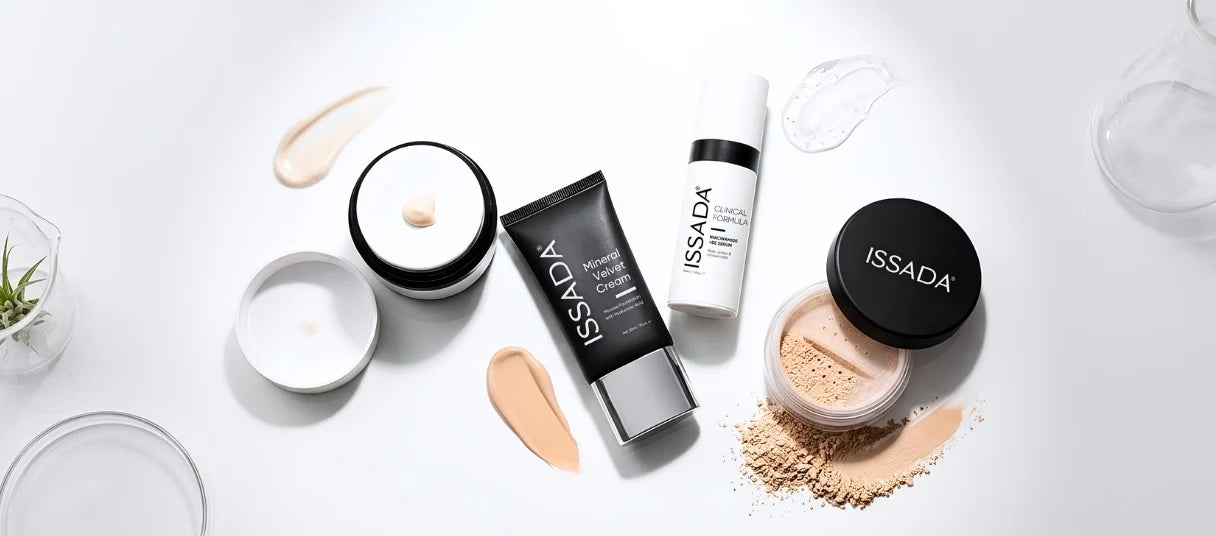
At ISSADA, we focus on professional-standard formulation: products built to be used consistently, layer well, and support visibly better-looking skin over time. If you want to understand the process better, see our guide on how cosmeceutical skincare formulas are developed.
Key Active Ingredients in Cosmeceutical Skincare
The most useful approach to cosmeceutical skincare isn't "more actives equals better." It is the right active, at the right strength, in a formula that your skin can actually tolerate.
Below are a few actives that show up often in cosmeceutical-style routines. Each behaves differently, so it's worth treating them differently too.
Niacinamide (Vitamin B3)
Niacinamide is one of the most versatile actives around and a reasonable starting point for most routines. Where it tends to help:
- more even-looking skin tone
- less visible congestion and minimised pores
- stressed or easily unsettled skin
- overall skin comfort
It's gentle enough for morning or night, and it layers easily with almost anything else you're using.
Vitamin C
Vitamin C's reputation for brightening is well earned: it supports brighter-looking, more even-toned skin, plus some antioxidant defence against everyday environmental stress.
The catch is that performance depends heavily on which form of vitamin C is used and how well the formula protects it from breaking down before it reaches your skin.
A vitamin C serum that's gone dull or oxidised in the bottle won't do much, no matter how promising the concentration looked on paper.
Retinoids and vitamin A (including retinol)
Retinoids are the most researched category on this list, and usually the one that people are most nervous about starting on. Use it consistently. They're associated with:
- softer-looking fine lines
- smoother-looking texture
- clearer-looking skin overall
The trick is patience: start with a couple of nights a week, keep the rest of the routine gentle, and build up frequency slowly as your skin adjusts.
Enzymes (gentler resurfacing)
For anyone who wants smoother-feeling skin without the grit of a physical scrub, enzyme exfoliants are worth a look. They work on the surface layer without the friction, which is part of why they're often chosen for more reactive or sensitised skin.
A Practical Routine: Skincare First, Makeup Second
We see this gap constantly: people invest in strong actives, then quietly undo the benefit with products that irritate the barrier, or with makeup that doesn't get along with post-treatment skin.
ISSADA's approach stays simple: high-performance formulas that still respect the skin barrier, built around routines that people can actually stick to. We explain this in more detail in our evidence-based approach to skincare in Australia.
Practical routine structure (AM and PM)
**Morning**
- Gentle cleanse
- Targeted serum (niacinamide or vitamin C, for example)
- Moisturiser as needed
- SPF daily, no exceptions
**Evening**
- Gentle cleanse
- Targeted serum (retinol on selected nights)
- Barrier-supporting moisturiser
If you'd rather follow a guided routine than build one from scratch, look for a curated pack built around your main concern, like dullness, uneven tone, or congestion.
Mineral makeup that doesn't fight your routine
If you wear foundation daily, how it sits on your skin matters most, especially when actives are part of the mix.
Talc-free mineral makeup tends to feel lighter and layers more easily over an active-heavy routine, which is part of why it's often the pick for sensitive or post-treatment skin.
FAQ
What is the difference between a cosmetic and a cosmeceutical?
Legally, there isn't one: both are regulated the same way, by the claims on the label rather than a special ingredient tier. "Cosmeceutical" is really just industry shorthand for a cosmetic formulated with more thought given to active concentration and stability.
Is cosmeceutical skincare better than regular skincare?
Not automatically. Fit beats category: a simple, well-matched moisturiser will often outperform an aggressive active routine that doesn't suit your skin.
What does clinical-grade skincare mean?
Mostly it's a promise about consistency: strict manufacturing controls and batch-to-batch reliability, so the product performs the same way every time, including on more reactive, post-treatment skin. It isn't a medical claim.
Can I use cosmeceutical products if I have sensitive skin?
Usually yes, especially if you start with gentle formulas and bring in stronger actives one at a time.
Do I need a prescription for cosmeceutical skincare?
No. These are sold for cosmetic use, full stop. If you're managing an actual medical skin condition, that's a conversation for a qualified health professional, not a product label.
How long before I see results?
Skin comfort often improves within days. Visible changes to texture and tone take longer, usually several weeks of consistent use before you can see results.
The Takeaway
At ISSADA, cosmeceutical skincare isn't about stacking as many actives as possible. It comes down to choosing the right ingredient, at a concentration that actually works, in a formula stable enough to keep working, then giving it consistent time on your skin. Get those basics right and the rest will follow.
Explore the full range on the ISSADA homepage to find a routine that fits your skin type and main concern.

Disclaimer: This content is for general information and isn't a substitute for advice from your own dermatologist, particularly if you have sensitive skin or a diagnosed skin condition.


Leave a comment