


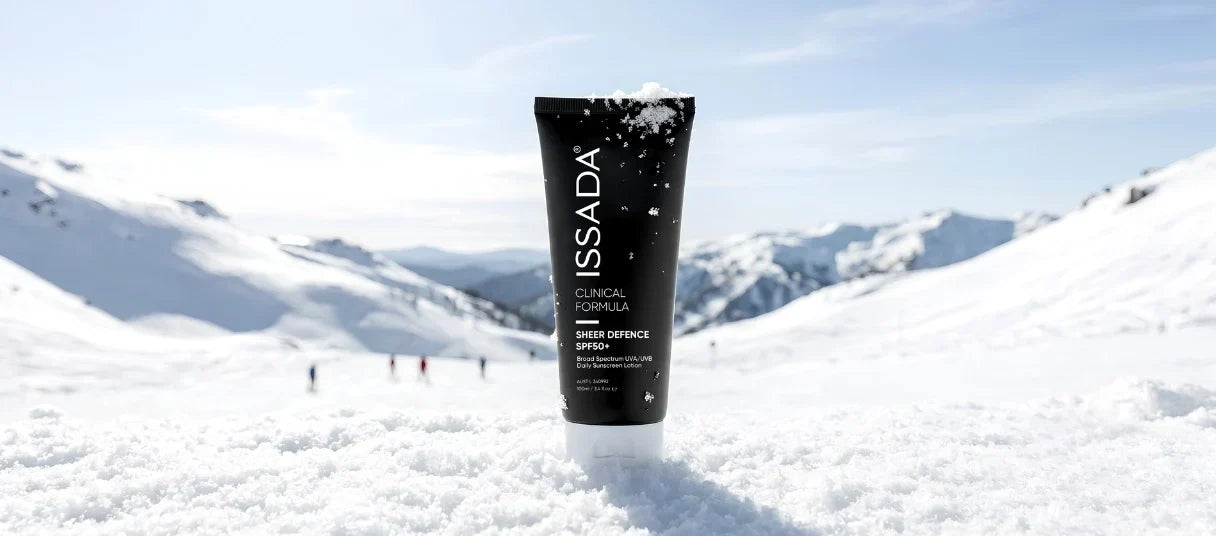


Do you need sunscreen in winter? In many parts of Australia, the answer is yes.
UV levels can still reach 3 or above during the cooler months, particularly in Queensland, the Northern Territory and parts of New South Wales, South Australia and Western Australia. Cold air and grey skies do not automatically mean low UV, which is why checking the daily UV Index is more reliable than judging the weather.
When protection is recommended, choose a broad-spectrum, water-resistant SPF 50+ sunscreen and combine it with protective clothing, shade, a broad-brimmed hat and sunglasses.
That does not mean your winter skincare routine has to feel heavy. The right facial sunscreen can protect your skin while sitting comfortably over moisturiser and beneath makeup.
In this guide, we explain three winter UV facts that can change the way you protect your skin and show you how to build SPF 50+ into your morning without disrupting the rest of your routine.
Key takeaways
- Check the UV Index, not the temperature, when deciding whether sun protection is needed.
- Cloud cover does not block all UV, so protection may still be necessary on cold, overcast days.
- UV exposure adds up over time, even when it comes from everyday activities such as walking, driving and eating lunch outside.
- Broad-spectrum SPF 50+ helps protect against both UVA and UVB radiation.
- Makeup should be applied over a dedicated sunscreen, rather than used as a replacement for one.
Table of contents
- Do you need sunscreen in winter?
- UV fact 1: Temperature does not tell you the UV level
- UV fact 2: Cloudy days can still expose your skin to UV
- UV fact 3: Small amounts of exposure add up
- How to choose the best sunscreen for winter
- How to apply SPF 50+ correctly
- Frequently Asked Questions
Do You Need Sunscreen in Winter?
You need sun protection whenever the UV Index reaches 3 or above or even when the day feels cool.
UV levels vary by location, time of year, time of day, altitude and cloud cover. Some southern parts of Australia may experience winter days when the UV Index stays below 3, while northern regions may require protection throughout the season. Checking your local forecast gives you a more accurate answer than following a blanket rule.
The SunSmart Global UV app and ARPANSA’s UV monitoring tools can show when protection is recommended in your area.
Making facial sunscreen part of your morning routine can also be practical when your day includes incidental outdoor exposure. A walk to the office, the school run, an outdoor coffee or a lunchtime errand may seem brief, but each moment contributes to your total UV dose.
The goal is not to fear being outdoors every minute. It is to know the UV level, protect exposed skin when necessary and use sunscreen correctly.
UV Fact 1: Temperature Does Not Tell You the UV Level
A cold morning can still be a high-UV morning.
The warmth you feel from sunlight comes largely from infrared radiation. UV radiation is different: you cannot see or feel it. This means your skin can be exposed even when there is no obvious heat or burning sensation. SunSmart advises that UV can be harmful on cool, cloudy days as well as warm, sunny ones.
That is why the thermometer is not a useful sun-protection guide.
UVA and UVB both matter
UV radiation that reaches the skin includes UVA and UVB.
UVB is the main cause of sunburn, while UVA contributes to premature skin ageing and is also associated with skin cancer risk. Both can damage the skin, which is why a sunscreen should be labelled broad-spectrum. Broad-spectrum protection means the product filters both UVA and UVB radiation.
You may notice UVB damage quickly because your skin becomes red or tender. UVA exposure can be less obvious, but repeated exposure contributes to visible changes such as uneven pigmentation, fine lines and loss of firmness.
What to change in your routine
Before heading outside, check the UV Index rather than relying on the temperature or season.
When it reaches 3 or above:- Apply broad-spectrum, water-resistant SPF 50+.
- Cover exposed skin where practical.
- Wear a broad-brimmed hat and sunglasses. Use shade, particularly around the middle of the day.
Sunscreen is an important part of this approach, but it should work alongside the other SunSmart measures rather than replace them.
UV Fact 2: Cloudy Days Can Still Expose Your Skin to UV
Clouds can reduce some UV, but they do not create a dependable protective barrier.
Thick clouds may filter more radiation than thin or broken clouds. However, UV can still reach ground level when the sky looks grey, and it is not possible to judge your exposure simply by looking outside.
This answers another common question: does sunscreen work on cloudy days?
Yes. A broad-spectrum sunscreen continues to protect your skin on overcast days when it is applied generously and used according to its directions. The need for protection should be based on the UV Index and your planned exposure is not whether you can see blue sky.
Do not rely on makeup alone
Foundation and powder can be part of your beauty routine, but they should not take the place of a sunscreen.
Most people do not apply complexion products at the quantity used during sunscreen testing. Makeup can also wear away unevenly during the day and is rarely reapplied in the same way as sunscreen.
A more reliable order is:
This gives you a consistent sunscreen layer without asking your foundation to do a job it was not designed to perform.
A sunscreen that also works beneath makeup
ISSADA Sheer Defence SPF 50+ is formulated as a lightweight daily sunscreen that can also act as a makeup primer. It has a broad-spectrum formula that provides UVA and UVB protection, offers two-hour water resistance and absorbs without a greasy or ghosting finish. It is suitable for dry and sensitive skin, making it a practical option when winter skin needs comfort as well as protection.
Because it is designed to sit beneath makeup, you can keep sun protection as a separate, dependable step without adding a thick or chalky layer to your routine.
UV Fact 3: Small Amounts of Exposure Add Up
UV damage is influenced by both the intensity of the radiation and the amount of time you are exposed.
A long afternoon outside is an obvious source of UV. But your overall exposure can also include the smaller periods you spend walking the dog, waiting for public transport, gardening or sitting outdoors.
ARPANSA explains that UV dose accumulates over time and that long-term exposure can increase the risk of skin cancer and eye damage. UV radiation can also contribute to premature skin ageing.
That makes consistency more useful than occasional perfection. A sunscreen that feels comfortable enough to apply regularly is more valuable than one that remains unused because it feels heavy, greasy or difficult to wear under makeup.

How to Choose the Best Sunscreen for Winter
The best sunscreen for winter is one that provides appropriate protection and feels comfortable enough to use correctly.
Cancer Council Australia recommends SPF 50 or SPF 50+, broad-spectrum and water-resistant sunscreen for the highest level of protection when the UV Index is 3 or above. It also notes that the best product is ultimately one you will use consistently and apply properly.
When comparing facial sunscreens, look for the following:
Broad-spectrum SPF 50+ protection
Broad-spectrum coverage is essential because it protects against UVA and UVB radiation. SPF 50+ provides a high level of protection when the correct amount is applied.
A comfortable finish
A sunscreen that feels excessively greasy or heavy may be tempting to skip. For daily facial use, look for a texture that spreads evenly, settles comfortably and works with your normal skincare and makeup.
Water resistance
Water resistance is useful beyond beach days. Sweat, exercise and unexpected rain can all affect your sunscreen layer.
Water resistance does not remove the need to reapply. Sunscreen should still be reapplied every two hours when you are outside, as well as after swimming, sweating or towel-drying.
Compatibility with dry winter skin
Cold weather and indoor heating can make skin feel dry or tight. Apply a moisturiser first and let it absorb.
Then apply sunscreen as your final skincare step before makeup.
ISSADA Sheer Defence SPF 50+ is a fast-absorbing, non-greasy and suitable for dry and sensitive skin. Its primer-like finish also helps reduce the need for several separate layers beneath foundation.
A Simple Winter Morning Routine
A useful routine does not have to be complicated.
Step 1: Cleanse gently
Use a cleanser that removes overnight oil and residue without leaving your skin feeling stripped. ISSADA Daily Gentle Cleansing Gel removes impurities without stripping essential lipids.
Dry or sensitised winter skin may respond better to lukewarm water than very hot water, which can leave the face feeling tighter.
Step 2: Apply your serum and moisturiser
Choose products based on your skin’s needs. If your skin feels drier during winter, a more nourishing moisturiser can help create a smoother base. ISSADA 25% Vitamin C Serum neutralises free radicals and provides that secondary line of defence against pigmentation.
Allow each layer to settle rather than applying everything at once.
Step 3: Apply SPF 50+
Apply ISSADA Sheer Defence SPF 50+ evenly over exposed skin as the final step of your morning skincare.
Pay attention to areas that are easy to miss, including:
- Ears
- Hairline
- Sides of the face
- Neck Upper chest
- Around the nose
Step 4: Allow it to settle before makeup
Sheer Defence is designed to double as a makeup primer, so foundation can be applied once the sunscreen has formed an even layer.
Avoid mixing sunscreen directly into moisturiser or foundation. Mixing products can make it harder to achieve even coverage and may reduce the amount of sunscreen applied.
Step 5: Reapply when needed
When you are spending time outdoors, reapply every two hours and immediately after swimming, heavy sweating or towel-drying.
Pair sunscreen with a hat, sunglasses, shade and protective clothing for more complete coverage.
Winter sports bring an extra consideration
Skiing and alpine holidays can create particularly high exposure.
Fresh, clean snow can reflect up to 90% of UV radiation on a sunny day. This can expose your face from the sun above and from reflected radiation below. UV levels also increase with altitude, which makes sunscreen, protective goggles, clothing and lip protection especially important in snowy environments.
Apply SPF 50+ generously to exposed areas such as the face, neck and ears. Reapply throughout the day, particularly after sweating or wiping your face.
How to Apply SPF 50+ Correctly
Using too little sunscreen can leave you with substantially less protection than the label indicates.
Cancer Council recommends approximately one teaspoon for an average adult’s head and neck, including the face and ears. For full-body coverage, the general guide is 7 teaspoons across the head and neck, limbs, and the front and back of the body.
Apply sunscreen to exposed skin around 20 minutes before going outside.
When outdoors, reapply at least every two hours, after swimming, after sweating heavily, after exercise and after towel-drying or wiping the face.
Even a two-hour water-resistant sunscreen must be reapplied. Water resistance describes performance under controlled testing conditions; it does not mean the product lasts indefinitely in everyday conditions.
Make SPF 50+ Your Year-Round Habit
Winter changes the way your skin feels, but it does not make UV disappear.
The most reliable approach is simple: check the UV Index, protect your skin whenever the level reaches 3 or above and choose a sunscreen you can use generously and consistently.
For anyone who dislikes the feeling of traditional facial sunscreen, ISSADA Sheer Defence SPF 50+ offers a practical combination of broad-spectrum protection, two-hour water resistance and a lightweight finish designed to sit beneath makeup.
A few minutes spent applying sunscreen in the morning can help protect your skin from sunburn, cumulative UV damage and premature ageing without weighing down your winter skincare routine.
Explore ISSADA clinical skincare and mineral makeup to build a routine around your skin type and seasonal needs.
Frequently Asked Questions
Do I need sunscreen every day during winter in Australia?
Check the UV Index each day. Sun protection is recommended whenever it reaches 3 or above, and many regions of Australia continue to experience these levels during winter. Some southern locations may have winter days below 3, so local UV information is more reliable than a single year-round rule.
Using Sunscreen SPF 50+ as part of your morning routine can still be convenient when your day regularly includes outdoor exposure.
Does sunscreen work on cloudy days?
Yes. Broad-spectrum sunscreen still works on cloudy days when applied generously and reapplied as directed.
Clouds may reduce UV, but they do not block it completely. Check the UV Index rather than assuming overcast weather means you are protected.
Is winter sun still dangerous?
Winter sun can still damage unprotected skin when UV levels are high enough. The risk is determined by the UV Index, exposure time, location, altitude and surrounding reflective surfaces, not by how warm the air feels.
UV radiation can contribute to sunburn, premature skin ageing, eye damage and skin cancer.
Is SPF 50+ too strong for winter?
No. The protection rating does not become excessive simply because the weather is cooler. Cancer Council recommends broad-spectrum, water-resistant SPF 50 or SPF 50+ when the UV Index reaches 3 or above. Correct application and reapplication are just as important as the number on the label.
Should sunscreen go before or after moisturiser?
Apply moisturiser first and give it time to settle. Sunscreen should then be applied evenly as the final step of your skincare and before makeup.
ISSADA Sheer Defence SPF 50+ is specifically formulated to sit beneath makeup and act as a primer, helping simplify this layering process.
Can I use foundation instead of sunscreen?
Foundation should not replace a dedicated SPF 50+ sunscreen.
Cosmetic products are not always applied in the amount required to achieve dependable protection. They can also wear away unevenly and may not be reapplied during the day. Apply your sunscreen first, allow it to settle and then add foundation.
Do I need extra protection in the snow?
Yes. Snow can reflect a large amount of UV, while higher altitude can increase exposure. Use SPF 50+ on exposed skin, protect your lips, wear UV-protective goggles or sunglasses and cover as much skin as practical. Reapply sunscreen at least every two hours.

Disclaimer: This content is for general information and isn't a substitute for advice from your own dermatologist, particularly if you have sensitive skin or a diagnosed skin condition.


Leave a comment